Photo-to-Illustration Prompts
Purpose: Photo filters for the camera-shy: Use AI to turn photos into watercolor illustrations, pencil sketches, and more. Preserve the atmosphere while simplifying or omitting facial features—making event photos more playful and sharing them a little less daunting.
Photo-to-Illustration Prompts edit
Faceless Watercolor Sketch edit
Prompt:
Transform this photo into a warm, natural watercolor sketch illustration with faceless figures.

Preserve the original landscape composition, camera angle, people’s positions and interactive poses, as well as the red-brick exhibition booth and posters on the left, the technology exhibition area on the right, the suspended drone, and the blue aisle. Capture the lively atmosphere of visitors exploring the exhibition.

Use translucent watercolor washes and light, slightly irregular pencil lines on warm, off-white textured watercolor paper. Render the red bricks in earthy reds and warm browns, and the exhibition area in soft blues and greens, while retaining the warm yellow lighting. Keep the brushwork loose and the colors luminous and transparent. Simplify background details moderately, like an on-location sketch in a travel journal.

Transform every person into a faceless, anonymous illustrated figure, including foreground figures, people in profile, partially obscured people, and small figures in the distance. Render faces only as smooth, subtle watercolor shapes, completely omitting eyes, eyebrows, noses, mouths, and all other identifiable facial features. For profiles, avoid protruding nose shapes, lip contours, or distinctive jawlines. Depict ears and hairstyles only in simplified form, without preserving the original individuals’ portrait likenesses.

Convey interaction through body posture, head orientation, and hand gestures, rather than facial expressions. The faceless treatment should blend naturally into the illustration style, creating a friendly, relaxed visual record of the event. Avoid a mask-like appearance or an eerie atmosphere.

Preserve the placement of headings and text blocks on the display boards. Represent small text with faint, short hand-drawn strokes, and do not add new text. Avoid photorealism, detailed portraits, large anime eyes, heavy oil-paint textures, bold black outlines, pixelation, blurred faces, or stickers covering faces.
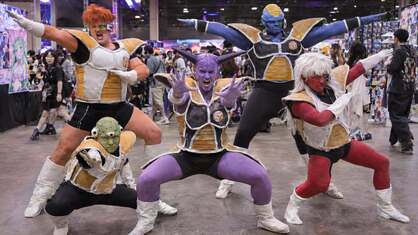
Original photo
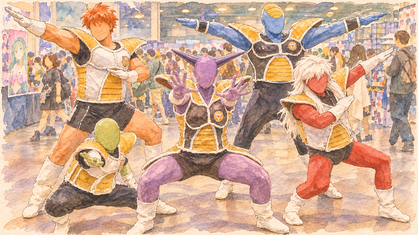
Faceless Watercolor Sketch
Naive Cubist Graphite Sketch edit
prompt:
Transform this photo into a naive cubist graphite pencil sketch on warm cream textured paper.
Simplify every person into flat geometric shapes: faces as tilted squares, diamonds, circles
and triangles; tiny dot eyes or two short vertical dashes for eyes; minimal mouths (small
curve, open oval, or triangle); triangular noses; hair as solid shaded triangular wedges.
Bodies are angular overlapping planes filled with loose diagonal zig-zag hatching.
Lines are wobbly, sketchy, doubled and broken, drawn with a soft HB pencil, slightly
grainy graphite texture. Background reduced to simple line structures — brick wall drawn as
dashed rectangles, window frames as straight rough lines, a curtain as vertical strokes.
Keep the original composition, number of people, poses and gestures (e.g. peace sign),
but flatten perspective and fragment forms like a child-like cubist drawing.
Monochrome gray graphite only, no color, lots of empty paper, playful and warm mood.
Original photo
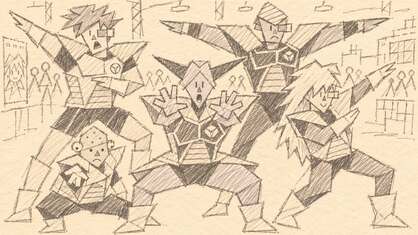
Naive Cubist Graphite Sketch